
अपनी मनपसंद भाषा में पढ़ें :
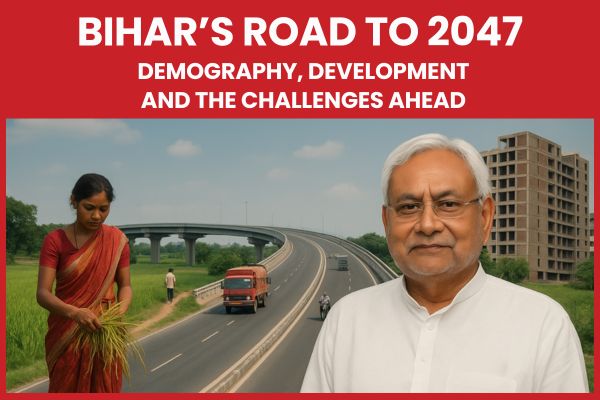
As CII projects Bihar’s economy to touch $1.1 trillion by 2046-47, the state stands at a turning point. Nitish Kumar’s governance has laid strong foundations in infrastructure, education, and law and order — but without industrialization, job creation, and climate resilience, the trillion-dollar dream may remain out of reach.
Patna (Nilabh Krishna) : The Confederation of Indian Industry’s (CII) projection that Bihar’s economy could touch $1.1 trillion by 2046-47 marks a transformative vision for a state historically known for poverty and underdevelopment. This projection also aligns with India’s broader ambition of becoming a developed nation by 2047. For decades, Bihar has been considered one of the weakest links in India’s growth story, but the last two decades have demonstrated that structural reforms, improved governance, and demographic advantages could alter its trajectory. The foundation laid under Nitish Kumar’s leadership has positioned the state for accelerated growth, though challenges in industrialization, employment, and human development remain pressing.

One of the key growth drivers for Bihar is its demographic dividend. With a population of nearly 13.5 crore (Census 2011) and more than 57 per cent of people below the age of 25, Bihar is India’s youngest state. This youth bulge, if productively employed, could contribute significantly to growth. The Gross State Domestic Product (GSDP) has already reflected signs of progress — Bihar clocked an impressive 10.59 per cent growth rate in 2021–22, compared to the national average of 8.68 per cent, making it one of India’s fastest-growing state economies. Agriculture continues to dominate, contributing 23 per cent to the GSDP, but the emergence of construction and services as high-growth sectors suggests gradual diversification. Food processing, textiles, dairy, and IT-enabled services are among the sunrise industries that could propel Bihar’s economy further if supported with the right policies.
Nitish Kumar’s government has been instrumental in steering Bihar onto this path. When he first came to power in 2005, the state’s economy was stagnant, and lawlessness had paralyzed governance. His early focus was on restoring law and order, which revived public confidence. Infrastructure became the second cornerstone: between 2005 and 2020, Bihar added over 60,000 km of rural roads under various schemes, improving connectivity and market access. Electrification also saw remarkable progress — while less than 20 per cent of households had power in 2005, today 100 per cent rural electrification has been achieved. In education, the “Mukhyamantri Balika Cycle Yojana” boosted female school attendance dramatically — the female literacy rate rose from 33.6 per cent in 2001 to 61.8 per cent in 2011, one of the sharpest increases in the country. These interventions laid the groundwork for a more skilled and aspirational society.
Healthcare too witnessed improvements. The number of functional Primary Health Centres (PHCs) grew nearly four-fold between 2005 and 2015. Institutional deliveries increased from 22 per cent in 2005 to nearly 75 per cent by 2019, reducing maternal mortality rates. Such progress reflects governance interventions that directly impact human development, a prerequisite for long-term growth. Nitish Kumar also empowered women politically — 50 per cent reservation in Panchayati Raj Institutions created thousands of women leaders, integrating gender inclusivity into governance.
Yet, despite these achievements, Bihar faces formidable challenges in achieving the $1.1 trillion economy vision. Industrialization remains weak — the state contributes barely 1 per cent to India’s industrial output, and per capita income is still among the lowest in India at around ₹54,000 (2022-23), which is less than half the national average. Unemployment and migration continue to plague the state — nearly 80 lakh Biharis work outside the state, sending back remittances that act as a lifeline for rural households. Without adequate local employment generation, the state risks underutilizing its young population. In higher education and skill development, Bihar lags — the Gross Enrolment Ratio in higher education is 14.5 per cent, well below the national average of 27 per cent. This leaves the workforce underprepared for high-value industries.
Climate vulnerability also threatens Bihar’s growth prospects. Over 70 per cent of Bihar’s population depends on agriculture, yet the state remains prone to annual floods in the north and recurring droughts in the south. For instance, the 2017 floods affected 1.7 crore people across 19 districts, underlining the need for resilient infrastructure and sustainable agricultural practices. Governance bottlenecks — particularly corruption, red tape, and political instability — further limit investor confidence. Unless governance reforms deepen, industrial and private investment may remain muted.
In conclusion, Bihar’s journey from a struggling economy to a projected $1.1 trillion powerhouse reflects both aspiration and cautious optimism. Nitish Kumar’s emphasis on governance, infrastructure, education, and healthcare has undeniably transformed the state, setting it on a path of sustained growth. The young population, rising literacy, improved connectivity, and emerging industries provide momentum. However, unless Bihar addresses the gaps in industrialization, job creation, skill development, and climate resilience, the trillion-dollar dream may remain elusive. The coming two decades will thus be decisive in determining whether Bihar can truly emerge as a growth engine within India’s larger vision of becoming a developed nation by 2047.
इसे भी पढ़ें : नीतीश कुमार : जंगलराज से सुशासन तक की यात्रा