
अपनी मनपसंद भाषा में पढ़ें :
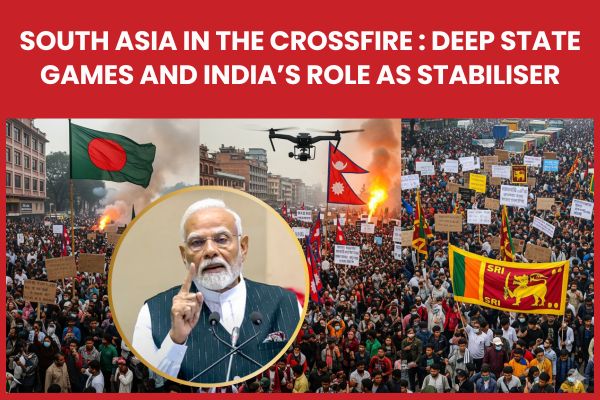
Nilabh Krishna, Patna : South Asia has long been described as one of the world’s most complex geopolitical theatres. In recent years, this complexity has turned into turbulence, with protests erupting earlier in Sri Lanka, then Bangladesh and recently in Nepal. The branding of these uprisings—whether “student protest” or “Gen-Z movement”—may sound organic and democratic, but the reality is far murkier. Behind the slogans and social media campaigns lies a pattern: a deliberate attempt by vested interests and deep state actors to destabilize India’s neighbourhood and redraw the regional balance of power.
“Arab Spring 2.0”
The so-called “Arab Spring 2.0” template is visible. First, popular discontent is amplified through online narratives, making protests look larger than life. Second, economic grievances are exploited to turn anger into regime change calls. Third, international media jumps in, presenting these movements as heroic struggles against tyranny. Finally, foreign funding and advisory networks quietly prop up leaders who align with external interests. This has been tried in Sri Lanka during its economic collapse, in Bangladesh under the garb of student unrest, and recently in Nepal with the sudden “Gen-Z” mobilization.
Nepal’s “Gen Z protests”
By all appearances, Nepal’s “Gen Z protests” looked like a fresh wave of student activism—a young generation rising against corruption and demanding accountability. But scratch the surface, and the movement looked less like a revolution and more like a regime-change script being played out in Kathmandu.
The irony is hard to miss. Sudhan Gurung, the face of these protests, claims to be fighting for a corruption-free Nepal. Yet the money fueling his group Hami Nepal comes from some of the most tainted figures imaginable. Among them: weapons dealer Deepak Bhatta, COVID profiteer Sahil Agarwal, and the celebrated surgeon Dr. Sanduk Ruit, whose Ramon Magsaysay Award ties him to Western intelligence-backed institutions. Fighting corruption with corrupt money? That’s not reform—that’s theatre.
The question is—who benefits? The answer points squarely to global power struggles. The United States, wary of losing its influence in Asia, has often used “democracy promotion” as a tool for intervention. China, equally ambitious, seeks to expand its footprint through Belt and Road projects and strategic investments. Both powers are vying for control of chokepoints, trade routes, and governments in South Asia. The chaos serves them well—it weakens local states, makes them dependent, and creates entry points for strategic dominance.
India stands as the outlier
In this theatre of manipulation, India stands as the outlier. Despite numerous attempts to trigger unrest—be it through misinformation campaigns, separatist narratives, or externally-funded NGOs—India has remained resilient. Its democratic institutions, while imperfect, are robust enough to absorb shocks without collapsing into chaos. For Washington and Beijing alike, this resilience is frustrating. India’s refusal to bend to foreign diktats and its insistence on charting its own path makes it the only true stabilizer in South Asia.
But this stability cannot be taken for granted. The deep state thrives on exploiting fault lines—religious divides, economic hardships, and youth disillusionment. Social media warfare has become its sharpest weapon, where hashtags become ammunition and narratives replace facts. Unless India and its neighbours remain alert, these psychological and political operations will continue to undermine regional peace.
What is striking is that the playbook is no longer confined to South Asia. Malaysia too is increasingly being targeted through protests and foreign narratives that seek to exploit domestic divisions and weaken its sovereignty. These moves are part of the same geopolitical chess game. At the same time, India faces a peculiar challenge at home—its own opposition leaders, especially Rahul Gandhi, often echoing foreign talking points, knowingly or unknowingly amplify narratives that undermine India’s standing. In the eyes of the deep state, such voices are convenient tools to attack India from within while external pressure mounts from outside.
South Asia does not need regime-change experiments. It needs genuine development, stronger democratic institutions, and cooperation among neighbours. India, as the region’s largest democracy and economic engine, must continue to anchor this stability while exposing the sinister designs of external forces. The message must be clear: South Asia is not a chessboard for great powers—it is home to sovereign nations whose people deserve stability, not engineered chaos.
इसे भी पढ़ें : Bihar’s Road to 2047 : Demography, Development, and the Challenges Ahead